Artist — Agnes Martin
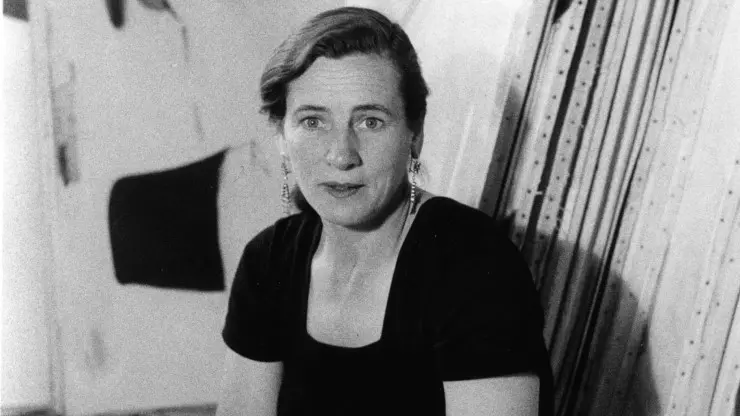
Agnes Martin
American, born Canada. 1912–2004
Agnes Martin was born in 1912 in Macklin, Canada, and grew up in Vancouver. She moved to the United States in 1932 and became a U.S. citizen in 1950.
She received a BS and an MA from Teachers College, Columbia University, New York, in 1941 and 1952, respectively, before establishing herself as an artist. For more than forty years, Martin created serene paintings composed of grids and stripes.
Her commitment to this spare style was informed by her belief in its ability to conjure profound, positive experiences in the viewer. At the age of thirty, while pursuing her bachelor’s degree, Martin decided to become an artist.
In 1947, after a few years of teaching, she settled in New Mexico and devoted herself to painting, eventually developing an abstract style informed by Cubism, Surrealism, and Abstract Expressionism. In 1957, on the advice of the New York gallerist Betty Parsons, she relocated to Coenties Slip in lower Manhattan,
where her friends and neighbors included artists Robert Indiana, Ellsworth Kelly, Lenore Tawney, and Jack Youngerman. By the late 1950s, Martin’s biomorphic works were supplanted by highly simplified geometric abstractions.
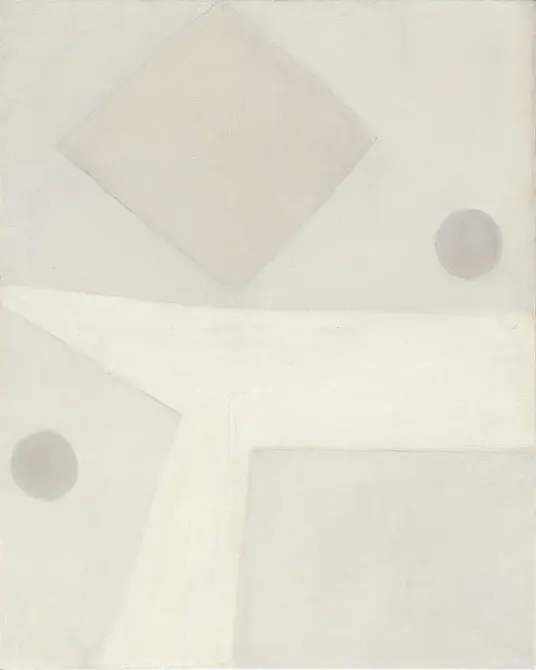
Harbor Number 1 (1957)
Harbor Number 1 (1957), one of Martin’s earliest New York paintings, combines the geometric abstraction of her earlier Taos work with the newfound inspiration of the harbor landscape, evident in her choice of blue-gray palette. These paintings were featured at her first show in New York, which took place at Section Eleven, an annex of the Betty Parsons Gallery, in 1958. Over the next six years Martin’s understated compositions evolved into subtle, dynamic monochromes featuring penciled grids on large, square, minimally prepared canvases.
In 1966, her work was included in the exhibition Systemic Painting at the Solomon R. Guggenheim Museum, which focused on painters working in reductive, methodical styles.
Martin abruptly stopped painting and left New York in 1967. at the height of her career, Martin faced the loss of her home to new development, the sudden death of her friend Ad Reinhardt, and the growing strain of mental illness; she left New York, and returned to Taos, where she abandoned painting, instead pursuing writing and meditation in isolation. In 1968, after traveling around the United States
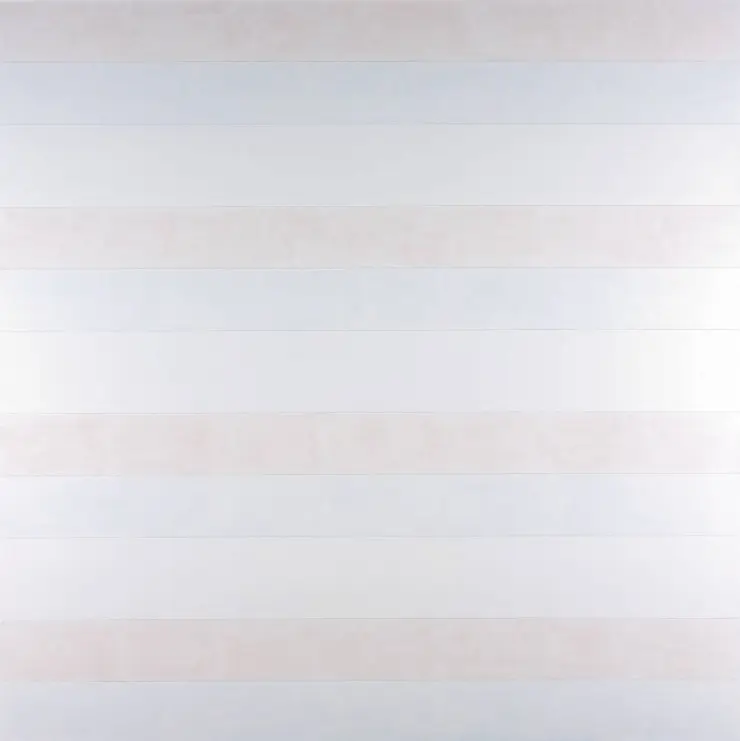
Untitled Number 5 (1975)
She returned to making art in 1972. Her return to painting in 1974 was marked by a subtle shift in style: no longer defined by the delicate graphite grid, compositions such as Untitled Number 5 (1975) display bolder geometric schemes—like distant relatives of her earliest works. In these late paintings, Martin evoked the warm palette of the arid desert landscape where she remained for the rest of her life. In 2003, Martin reintroduced bold geometric forms into her compositions. These late works recall the paintings she made in her first years on Coenties Slip in New York, while remaining distinctly informed by the intervening body of work. Martin died in Taos, New Mexico, in 2004.